From Overwhelmed to Overcoming
Biblical Wisdom Meets Modern Science for Lasting Well-being
My motivation for writing this book stems from the realization that the vast majority of people I have coached were stressed, burned out, and lived a life that was less than balanced, and they were unable to do anything about it.
Then, I read in Langspur and Klemp (2016): “We can let the ordinary habits of the mind fly the plane and then, when we get there, stress and tension show up to see us to our regular destination. Alternatively, we can redirect our attention, and we can retrain our minds to experience a more optimal state of well-being” (Langshur & Klemp, Ph.D., 2016, p. 33).
With the knowledge and experience I had acquired, I decided to be part of the solution, helping people learn that they have the power to redirect their attention and retrain their minds to experience a more optimal state of well-being. These are the reasons why I am writing this book.
Book’s Purpose and Spiritual Significance
This book demonstrates how biblical wisdom, neuroscience research, and social science converge to make mindfulness an effective Christian approach for reducing stress and burnout, promoting work-life balance, and enhancing emotional intelligence. Grounded in Paul’s confession in Romans 7: 15, “I do not understand what I do. For what I want to do, I do not do, but what I hate I do” (New International Version, 1973/1997), and his promise in Romans 12: 2, “Do not conform to the pattern of this world, but be transformed by the renewing of your mind” (New International Version, 1973/1997), this book takes the reader on a journey of inner change.
The spiritual significance of this book lies in its ability to enable believers to understand that the struggle with reactive patterns is not a character flaw—it is neurological and is addressed by the biblical prescription for mind renewal, which has received empirical validation in light of recent research on neuroplasticity.
How the Book Offers Encouragement and Empowers Christian Readers
Moving beyond conventional “willpower” or “self-discipline” strategies, this book empowers readers by revealing that transformation is scientifically possible and biblically promised.
Through Frank’s relatable journey and the practical CAPTURE method, readers discover they can:
- Break free from destructive reactive patterns that damage relationships.
- Experience the “peace that transcends understanding” through practical application.
- Integrate their faith with evidence-based stress management techniques WITH mindfulness strategies.
- Develop emotional intelligence that reflects Christ-like character.
- Create work environments that honor God while reducing burnout.
Why Readers Need This Book
The statistics reveal an urgent crisis: “70% of Americans report experiencing physical or nonphysical symptoms of stress” (Langshur & Klemp, 2016, p. 194), while “About 75% of Americans reported experiencing a physical or mental symptom of stress in the last month” (Dershowitz & Berger, 2025, para. 1). For Christian professionals, this creates a spiritual crisis—feeling disconnected from God’s peace while struggling with reactive patterns that contradict their faith values.
The financial impact compounds the problem: “When replacing an employee who quit due to burnout, the replacement cost can be as high as 213% of the departing employee’s salary” (Somanathan, 2024, para. 25), while “Stanford researchers calculated how workplace stress impacts health costs and mortality in the United States—roughly 8% of national healthcare spending—and nearly 120,000 deaths each year” (Goh et al., 2016, para. 1).
The CAPTURE Mindfulness Model, introduced in the book, provides an elevated perspective and serves as our anchor, thereby enhancing self-awareness. Increased self-awareness enables emotional regulation, the ability to observe and capture thoughts, reframe them with gratitude or positive thoughts, and replace reactive, counterproductive behaviors with more productive ones, such as active listening, empathy, compassion, or problem-solving skills, introduced in the book as relationship-building choices.
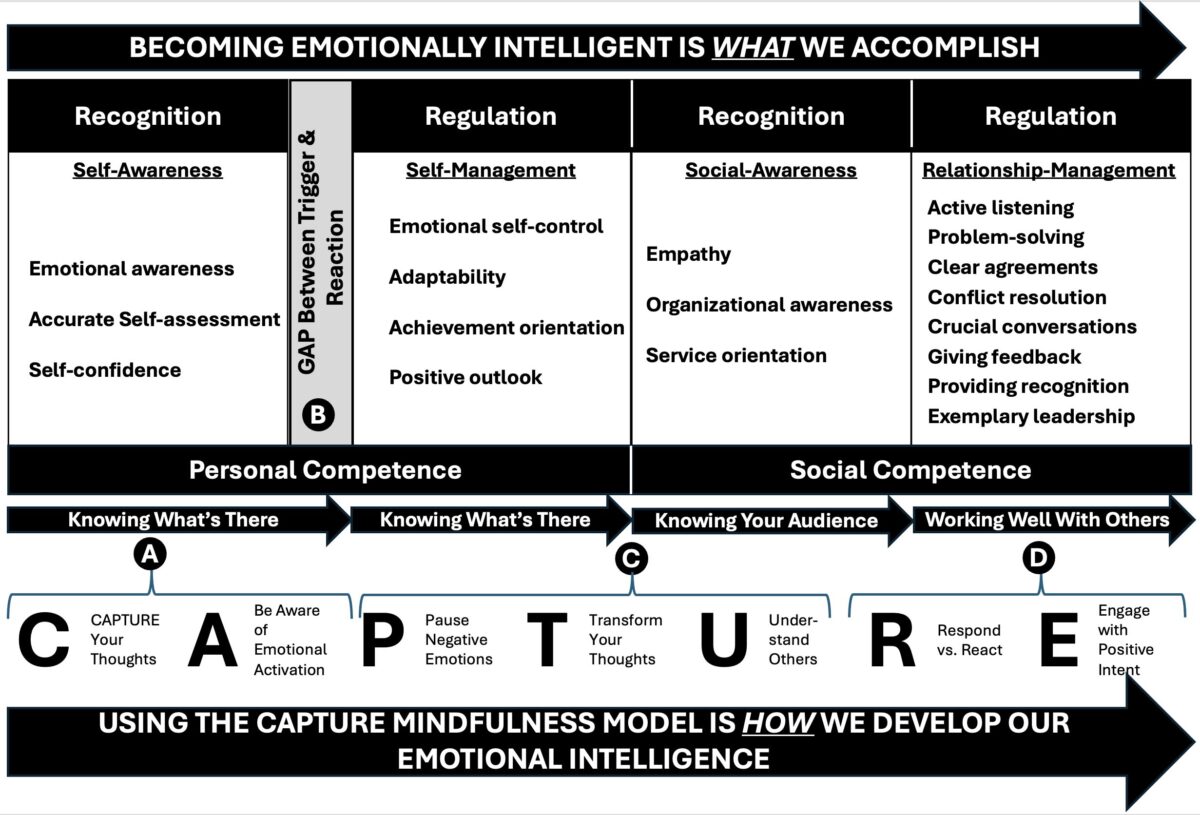
The book also presents a model that illustrates how CAPTURE Mindfulness—Emotional Intelligence Connection helps people navigate the Emotional Intelligence model, enabling them to choose effective relationship-building skills. NOTE: Each of the relationship-building skills has a dedicated chapter.
-
Capture Your Thoughts and Be Aware
What happens: You notice the early warning signs—that tightness in your chest, the flash of irritation, the urge to react immediately.
Why it matters: Self-awareness is your foundation. Without recognizing what’s happening internally, you remain at the mercy of automatic reactions. This step gives you the crucial moment of recognition: “Something is shifting inside me.”
The breakthrough: You move from unconscious reactivity to conscious awareness. - The GAP Between the Trigger and Reaction
Using the GAP between the trigger and reaction(s), you move from unconscious reactivity to conscious awareness. The pivot point for moving to the trio of steps occurs in step 3: Pause, Transform, and Understand—the Heart of Your Transformation. Here, you shift from being controlled by emotions to managing them strategically. - The Heart of Transformation and Improving Emotional Intelligence
Pause: You deliberately create space between stimulus and response. It’s not just passive waiting—it’s active emotional regulation.
Transform: You consciously reframe your thinking from negative to positive, from victim to empowered responder.
Understand: You expand your awareness beyond yourself to grasp the broader social dynamics at play. What might others be experiencing? What factors are influencing this situation?
The breakthrough: You move from self-management to social awareness, positioning yourself to respond with both wisdom and empathy. -
R—Respond (Do not React) and E—Engage with Positive Intent
Armed with awareness, emotional control, and social understanding, you’re now prepared to choose your response strategically.
Respond vs. React: Your response becomes intentional rather than impulsive. You select actions aligned with your values and desired outcomes rather than your immediate emotional impulses and counterproductive reactions. Interpersonal skills that foster effective communication and build relationships.
Engage with Positive Intent: You approach interactions with a genuine desire for positive outcomes, bringing your best self to every moment in every relationship.
The breakthrough: You consistently demonstrate relationship management skills that build trust, solve problems, and strengthen connections.